🌿 Your trusted guide to choosing the best garden tools.

Loop Hoe: What It Is, How to Use It, and How to Choose the Right One

Weeding has a reputation problem. Most people picture it as an hour on their knees, tugging at stubborn green shoots while the sun climbs higher. Yet a surprising number of experienced growers barely bend at all. They walk their beds with a long handle, a thin metal ring on the end, and a rhythm that clears a row in minutes.
That ring is the heart of the loop hoe, and it is one of the most misunderstood tools in the shed. Search for it and you will find a stirrup-shaped head that swings on a pivot, a rigid stainless ring used almost upright, and a heavy steel hoop sold at hardware stores. They all carry the same name, yet they behave differently in your hands.
This guide untangles all of it. You will learn what the tool is, how the two main designs differ, which blade width fits your garden, how to use it without clipping your crops, and how to keep the edge sharp for years. We will also cover a few things most guides skip, such as what a sharp hoop can do to a drip line.
Quick question before we start: where are your weeds? Packed between lettuce rows, spread across a wide path, or creeping into mulch around shrubs? Hold that picture in mind. The right choice depends on it, and we will come back to it more than once.
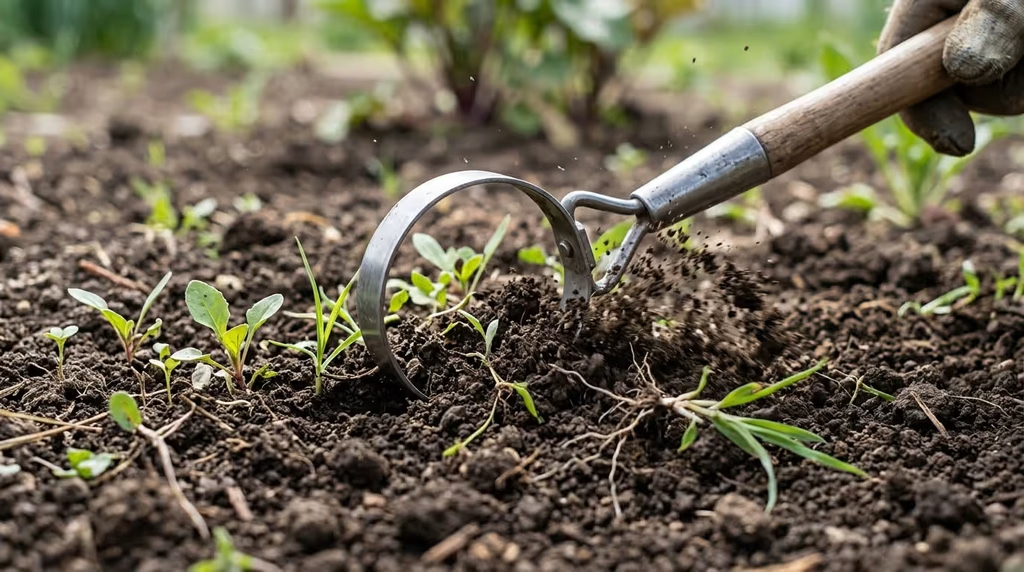
Weeding Between Crop Rows with a Long-Handled Loop Hoe

What Is a Loop Hoe?
A loop hoe is a long-handled weeding tool whose blade is a loop of sharpened metal instead of a solid paddle. You drag, push or sweep that loop through the top layer of soil, and its edges slice weeds off at or just beneath the surface. Because the middle of the blade is open, soil and cut weeds pass through rather than piling up in front, and you can see exactly where the cutting edge sits.
That open design is the whole point. A solid blade hides the ground behind it. A loop lets you watch the edge slide past a seedling and stop a hair before it. Growers who work in tight beds often cite that visibility as the reason they reach for this tool first.
Why the Name Is Confusing
Here is where shoppers get tripped up. The name covers two quite different designs:
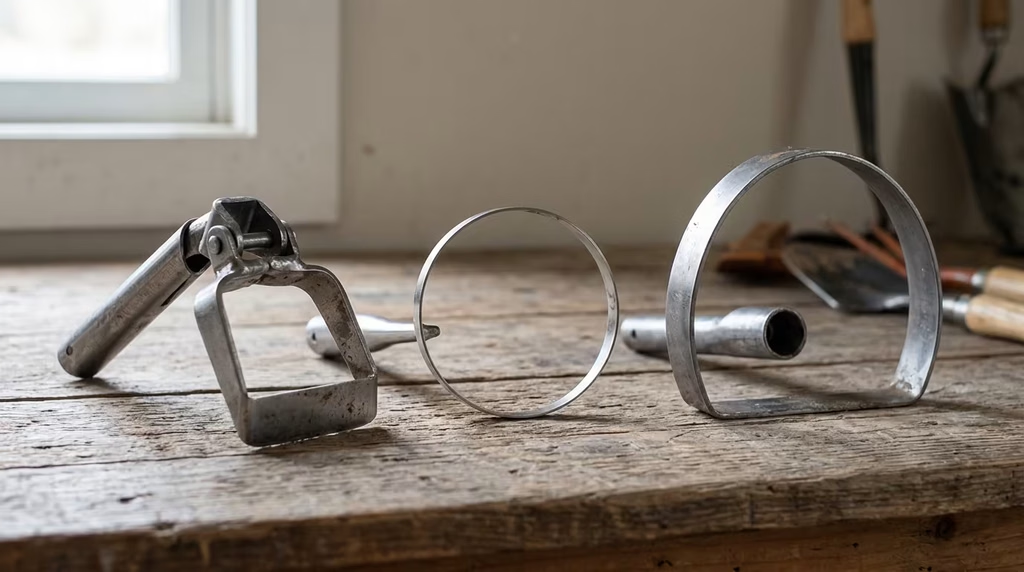
- The pivoting stirrup type. The head is shaped like the stirrup on a saddle and rocks on a pin at the socket. Both long edges are sharp, so it cuts when you push and again when you pull. Many sellers call it a loop, hoop, stirrup, oscillating, action or hula hoe, and they use these labels interchangeably.
- The fixed upright type. A slim ring of stainless steel, sometimes only about three inches wide, fixed rigidly to the handle. You hold it close to vertical and sweep it, a technique closer to a collinear hoe than a stirrup. Lee Valley sells a version like this, with a 54-inch hardwood handle.
Neither interpretation is wrong. Knowing which one you are looking at prevents the disappointment of buying a pivoting head when you wanted a precise tool for tight spaces, or the reverse.
Other Names You Will Meet
- Hoop hoe
- Stirrup hoe
- Oscillating hoe or action hoe
- Hula hoe (a brand name that became a generic label)
- Swivel hoe or pendulum weeder
- Shuffle hoe
If you want a deeper comparison of the broader family, our guides on the stirrup hoe and the scuffle hoe cover the pivoting and fixed-blade ideas in more depth. This article stays focused on the loop itself.
Loop Hoe Types Compared With Related Tools
The table below shows where this tool sits among its closest relatives.
| Tool | Blade shape | Cutting action | Best for | Main drawback |
|---|---|---|---|---|
| Pivoting stirrup type | Hinged loop, two sharp edges | Push and pull | Open beds, paths, large areas | Clumsy right beside seedlings |
| Fixed upright ring | Thin rigid ring | Sweeping, near vertical | Tight rows, close spacing | Takes practice to feel the depth |
| Collinear hoe | Flat narrow blade | Pull, held nearly flat | Precision beside crops | Less effective on larger weeds |
| Dutch hoe | Flat blade, forward edge | Mostly push | Loose soil, light weeds | Struggles in compacted ground |
| Draw hoe | Heavy paddle at 90 degrees | Chop and pull | Shaping soil, big weeds | Tiring on large areas |
| Wire weeder | Bent wire, flexible | Gentle scrape | Beds with drip tape | Too light for tougher weeds |
Which row describes your garden? If your plants stand close together, the fixed ring or a narrow pivoting head is your friend. If you have wide aisles to clear, the pivoting head covers more ground per stroke.
Anatomy of a Loop Hoe
A few details separate a tool that lasts a lifetime from one that bends in the first season.
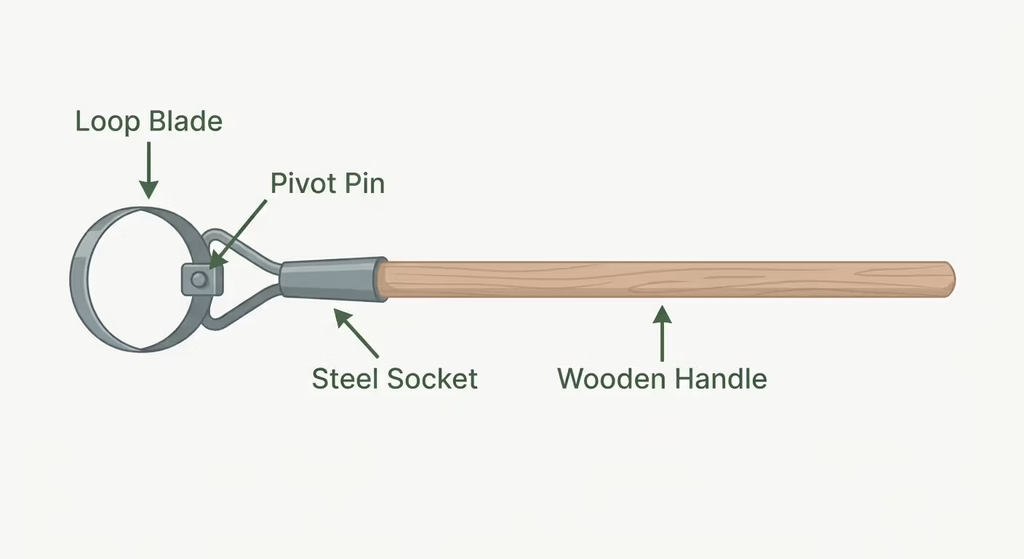
- The loop (blade). The cutting element. Look for hardened or stainless steel with edges that are actually sharpened. Thin gauge steel moves through soil with less resistance, though it can flex if you hit a stone. One retailer lists a 12-gauge hoop, a reminder that steel thickness is worth checking.
- The pivot or fixed joint. On a pivoting model, check that the pin sits snugly and moves freely without wobble. On a fixed ring, check that the weld or fastening looks clean.
- Socket or ferrule. The collar joining head to handle. A long steel socket holds better than a short crimped one.
- Handle. Hardwood such as ash is warm and absorbs vibration. Fiberglass is light and shrugs off weather. Lengths around 54 to 60 inches suit most adults, and longer options exist for tall users.
- Head width. Commonly sold sizes include roughly 3, 5 and 7 inches. Narrow widths get close to plants, while wide ones sweep paths quickly.
Parts of a Loop Hoe at a Glance
What This Tool Is Used For
For a tool with such a simple shape, it earns its keep in several jobs.
- Weeding young beds. Its primary job. It shaves off seedlings and small weeds before they take hold, including tiny ones too small to see.
- Working between crop rows. The open loop and narrow widths let you travel between rows of onions, carrots, lettuce, beans or flowers.
- Light surface cultivation. A shallow pass breaks the crust that forms after rain, helping air and water reach roots.
- Clearing paths and open ground. A wider pivoting head quickly tidies aisles, gravel edges and bare patches.
- Cleaning up old crops. Some growers use it to knock out spent rows of leafy greens before replanting.
- Pulling soil lightly around plants. The flat sides of a stirrup-shaped head can nudge loose soil toward a plant base for a gentle hilling effect.
A fair warning: this is a surface tool. It does not dig, and it will not uproot established perennials with deep roots. For dandelions, dock or bindweed you will need something that reaches deeper, such as a hand weeder or a digging fork.
Who Should Use This Tool?
You will probably enjoy this tool if you:
- Grow vegetables or cut flowers in rows or raised beds
- Want to weed standing up, with less bending and kneeling
- Garden on closely spaced plantings where a heavy hoe would be clumsy
- Look after a market garden or small farm and need quick, repeatable passes
- Maintain mulched borders, paths or the edge of a gravel drive
- Prefer a lightweight tool you can use for an hour without tiring
You may want something else if your soil is full of stones, or if your main enemy is thick, deep-rooted perennial growth.
How to Choose the Right Loop Hoe
Work through these steps and you will sidestep the usual buying mistakes.
- Decide which design suits you. Pick a pivoting stirrup head for speed over open ground. Pick a fixed upright ring for close, careful work. Many serious gardeners eventually own one of each.
- Measure your row spacing. A head that is too wide will clip crops. A useful rule is to choose a blade a little narrower than the gap between plants, so you have room to work without touching them.
- Check your irrigation. If you run drip tape on the surface, read the section on drip lines below before buying anything with a sharp, deep-cutting hoop.
- Inspect the steel. Hardened or stainless steel keeps an edge and resists rust. Soft, thin metal dulls fast and distorts.
- Try the handle length. You should stand upright with the head flat on the ground. If you must stoop, the handle is too short. Around 54 inches suits many adults.
- Think about weight. Light tools are kinder over a long session. A heavier head gives more authority in firm ground.
- Look for replaceable parts. Some makers sell spare blades and handles separately, so a bent loop does not mean a dead tool.
- Match your budget to your use. A big-box hoe with a fiberglass handle can be a perfectly good starter. Specialist makers charge more but build for daily use. Prices change often, so compare current listings before you commit.
Popular Loop Hoe Options
These names appear again and again in search results. Treat the notes below as a starting point and check current specifications.
Lee Valley Loop Hoe
This is the clearest example of the fixed, upright style. Its slim stainless steel loop is around 3 inches wide, which lets it slide between close plants, and the open centre lets you see the edge as it works. It comes with a hardwood handle about 54 inches long. Lee Valley’s own care advice recommends rinsing the loop and socket after working in clay, and storing the tool so the blade is not resting on its tip. If you garden in tight beds, this is the style to study.
Hula-Ho and Other Pivoting Types
Hula-Ho is the brand that popularised the oscillating stirrup head, and it is sold with hardwood handles in several lengths, including long 54-inch and compact 14-inch versions. Hoss Tools also lists a replacement oscillating blade, which is a handy detail if you ever bend one on a stone.
Bully Tools 12-Gauge Loop Hoe
Sold through Home Depot with a fiberglass handle, this is a budget-friendly option with a limited lifetime warranty on materials and workmanship. It is a sensible pick if you want an everyday tool for general landscaping and bed maintenance without paying for hand-built quality.
Seymour 60-Inch Hoop Hoe
For taller gardeners, a 60-inch handle is a welcome change. Seymour lists a model at that length, and the extra reach helps you keep your back straight.
want to know about stone
Pivoting, Slim Ring and Wide Hoop Heads Compared
How to Use a Loop Hoe (Step by Step)
Good technique beats strong arms every time. Follow these steps with your loop hoe for clean cuts and tire-free evenings.
- Start early in the season. Hoe while weeds are tiny, ideally at the thread stage when they have barely germinated. A quick pass then removes thousands before you even notice them.
- Choose dry weather. Cut weeds shrivel on the surface in dry, sunny conditions. In wet spells they can re-root, so rake them off.
- Check the soil. It should be workable, not sticky and not dust-dry. Soggy soil clogs the loop. Rock-hard soil makes the blade skip.
- Stand tall. Hold the handle with both hands and a soft grip. Let your body weight carry the stroke rather than your arms.
- Set the depth. Aim to work only the top inch of soil, and often less. Going deeper wastes effort, can damage soil structure and brings dormant weed seeds up to the light.
- Pivoting type: push and pull. Slide the head forward and back in a smooth, shallow stroke. The pivot adjusts the angle for you and the edges cut in both directions.
- Fixed upright type: sweep. Hold the ring near vertical and draw it toward you in a short arc, like a collinear hoe. Keep strokes short near plants and longer in open ground.
- Work backward. Move so you do not tread on freshly cleared ground. Footprints compact soil and press weed seeds into the surface.
- Choke up near crops. Slide a hand down the handle for finer control and use short strokes where plants crowd in.
- Collect or leave. In dry weather leave small cuttings to wither. In damp weather rake them away.
- Repeat often. One session does not finish the season. A light pass every week or two keeps weeds permanently tiny and the job permanently easy.
Special Situations
Between closely spaced seedlings: Use the narrowest head you have. If weeds sit within a couple of inches of delicate plants, switch to a hand tool for those last few centimetres.
Over a gravel path: Slide the head just under the surface with light pressure rather than forcing it down. Then rake the cut weeds away.
Under mulch: A slim, rigid ring slips beneath the mulch with less fuss than a wide pivoting frame.
Keeping the Loop Shallow, Only the Top Inch of Soil
The Drip Line Warning Most Guides Skip
Here is the gap that many articles leave out. If your beds use surface drip tape, a sharp hoop can slice straight through it. Growers who rely on drip irrigation report this is one of the most common ways to ruin a morning, because a nicked line leaks quietly until you notice a soggy patch and a dry crop.
You have a few sensible options:
- Bury the tape a little deeper, where a shallow-working hoe will not reach it.
- Switch tools in those beds. A flexible wire weeder glides over tape without cutting it.
- Use the hoop only in the aisles and handle the zone around the tape by hand or with a gentle tool.
- Mark your lines before you start, so you remember where they run when concentrating on the weeds.
A few seconds of planning here saves a repair job later.
Loop Hoe Maintenance and Care
A dull edge turns a pleasant task into a slog. Fortunately, care takes minutes.
- Sharpen regularly. A flat file works well on the outer edges of the loop. Match the existing angle and do not overdo it, because a razor-thin edge wears away fast.
- Rinse after clay. Wet clay clings to the loop and socket. Rinse it off so buildup does not corrode the joint.
- Dry before storage. Moisture causes rust and water spots. Wipe the blade and let it dry fully.
- Oil the steel. A thin wipe of camellia or linseed oil protects non-stainless blades over winter.
- Straighten gently. If the loop bends after striking a stone, ease it back carefully. Avoid bending the same spot repeatedly, which weakens the metal.
- Store it properly. Hang it up or lay it flat. Leaning it on the blade tip can deform the loop.
- Look after the handle. Wooden handles appreciate a coat of boiled linseed oil each year. Sand away any splinters.
- Check the joint. A loose head is a safety issue. Tighten or replace fasteners if you feel play.
Pro tip: touch up the edge at the start of the season, then give it a few quick file strokes every few sessions. Little and often beats one big sharpening day.
Common Mistakes to Avoid
Be honest, do you recognise any of these?
- Digging too deep. It tires you, upsets soil structure and invites a fresh crop of weeds.
- Waiting too long. The tool shines on small weeds. Large, woody ones with deep roots will laugh at it.
- Hoeing wet soil. Mud clogs the loop and smears the surface.
- Ignoring a dull edge. A blunt blade bruises weeds instead of cutting them, and they bounce back.
- Forgetting the drip tape. See the section above.
- Choosing a head that is too wide. Bigger is not better when plants stand close together.
- Chopping instead of gliding. This is not a draw hoe. Keep the strokes low, long and smooth.
- Expecting it to kill perennials. Cutting the top of a deep-rooted plant just invites regrowth.
A Few Extra Tips From the Gaps in Other Guides
Pair hoeing with mulch. After a pass, a thin layer of mulch blocks light and slows new seedlings. The two methods together beat either alone.
Hoe before you see weeds. A quick pass over seemingly bare soil can destroy a carpet of invisible seedlings.
Space your crops for your tool. Many gardeners plant their rows to match the width of their favourite blade. It makes every future pass quicker.
Mind your feet. The edges are sharp. Wear closed shoes and keep the head away from your ankles.
Know when to change tools. Once the big weeds are gone, a precision tool like a collinear hoe or wire weeder handles the fiddly work near plants.
Table of Contents
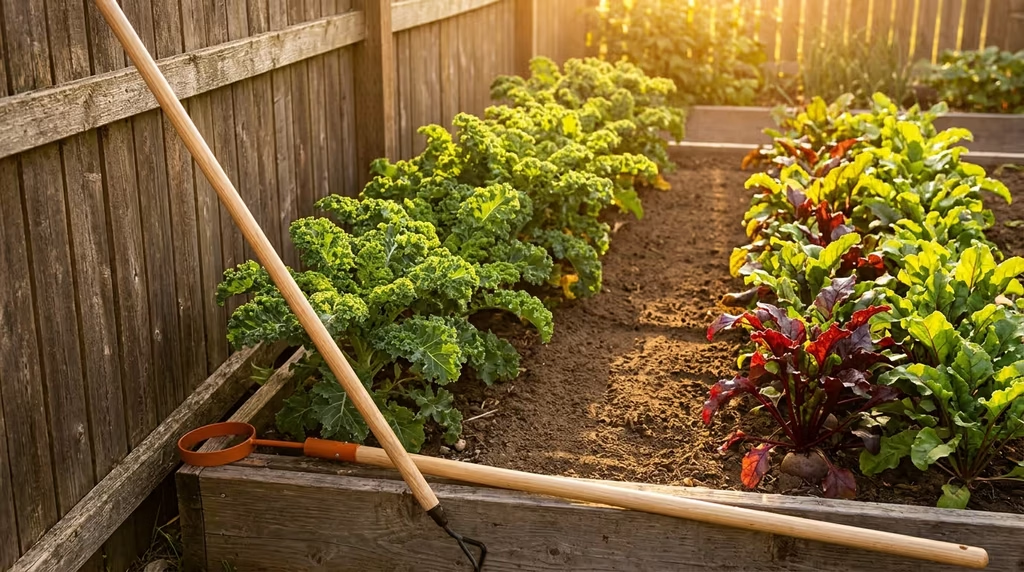
A Tidy, Freshly Weeded Bed After a Quick Pass
Frequently Asked Questions
What is a loop hoe?
It is a long-handled weeding tool with a hoop-shaped, sharpened metal blade. You drag or sweep it through the top inch of soil to cut weeds at the base. The open centre lets you see the edge while you work.
What is a loop hoe used for?
Mainly for weeding vegetable beds, flower borders, mulched areas and paths. It also lightly cultivates the soil surface.
Is a loop hoe the same as a stirrup hoe?
Often yes. Many sellers use the names for the same pivoting stirrup-shaped tool. A separate fixed, slim ring design also goes by the name, so check the product photos and description.
What is the best loop hoe for weeding?
It depends on your layout. For tight rows, a slim fixed ring is hard to beat. For wide beds and paths, a pivoting head covers more ground. For budget convenience, a fiberglass-handled hoop from a hardware chain is a fair start.
What size should I buy?
Choose a head slightly narrower than the gap between your plants. Common sizes run from about 3 to 7 inches.
How deep should I hoe?
Only the top inch of soil, and often less. Shallow work cuts weeds without dragging up new seeds.
Will it damage drip irrigation?
It can. A sharp blade may slice surface drip tape. Bury the line, work only in the aisles, or use a wire weeder near it.
Can it remove perennial weeds?
Not reliably. It removes top growth, but deep roots can regrow. Use a digging tool for those.
How do I sharpen it?
Use a flat file along the cutting edges, following the existing angle. Avoid making the edge razor-thin.
Can I use it on gravel?
Yes. Slide the blade just under the surface with light pressure and rake away the cuttings while weeds are small.
Final Thoughts
A loop hoe will not make weeds disappear forever, but it changes your relationship with them. Instead of dreading a long, back-breaking session, you spend a few relaxed minutes each week gliding a thin blade through the top inch of soil. The weeds never grow large enough to matter.
To recap: pick the design that matches your spacing, choose steel that holds an edge, keep your strokes shallow, protect your irrigation lines, work while weeds are tiny and sharpen often. Do those things and a good tool can last for decades.
Your turn: are you leaning toward a pivoting head for open beds or a slim ring for tight rows? Tell us about your garden in the comments, and let other readers help you decide.
Touching Up the Edge with a Flat File
