🌿 Your trusted guide to choosing the best garden tools.

Garden Fork 101: The Tool That Turns Soil Without Wrecking It

Ask yourself this: when you need to break up a compacted bed before planting, lift a crop of potatoes without spearing half of them, or turn over a section of lawn to prep for a new border, does a shovel actually do that job well, or does it just compact the soil further with every push? That’s exactly the gap a garden fork fills. Its tines slide between soil particles and roots instead of slicing through everything in one solid mass, which makes it one of the most underused tools in most sheds.

Table of Contents
So, What Is a Garden Fork?
A garden fork (also called a spading fork or digging fork) is a long-handled, two-handed tool with four sturdy, flattened tines instead of a solid blade, built for turning, breaking up, and aerating soil. It looks like a smaller, heavier-duty cousin of a pitchfork, but it’s built for dense ground rather than loose material like hay or straw.
A garden fork typically handles:
- Turning and loosening compacted soil before planting
- Digging and lifting root crops — potatoes, carrots, garlic — without slicing through them
- Breaking up clumps of clay or heavy soil that a shovel would just compress
- Aerating lawns and garden beds
- Working compost or manure into an existing bed
- Dividing large, root-bound perennials
If the job is “cut and scoop,” reach for a shovel. If it’s “loosen, lift, or turn without destroying what’s underneath,” reach for the fork.
Garden Fork vs. Pitchfork vs. Hand Fork — Quick Clarity
These three get confused constantly, so here’s the short version: a garden/spading fork has short, thick, flattened tines built for digging into dense soil; a pitchfork has longer, thinner, rounded tines built for lifting loose material like hay, mulch, or leaves — not for digging; and a hand fork is a small, single-hand version of a spading fork, used for close-up weeding and loosening around existing plants rather than full-bed digging.
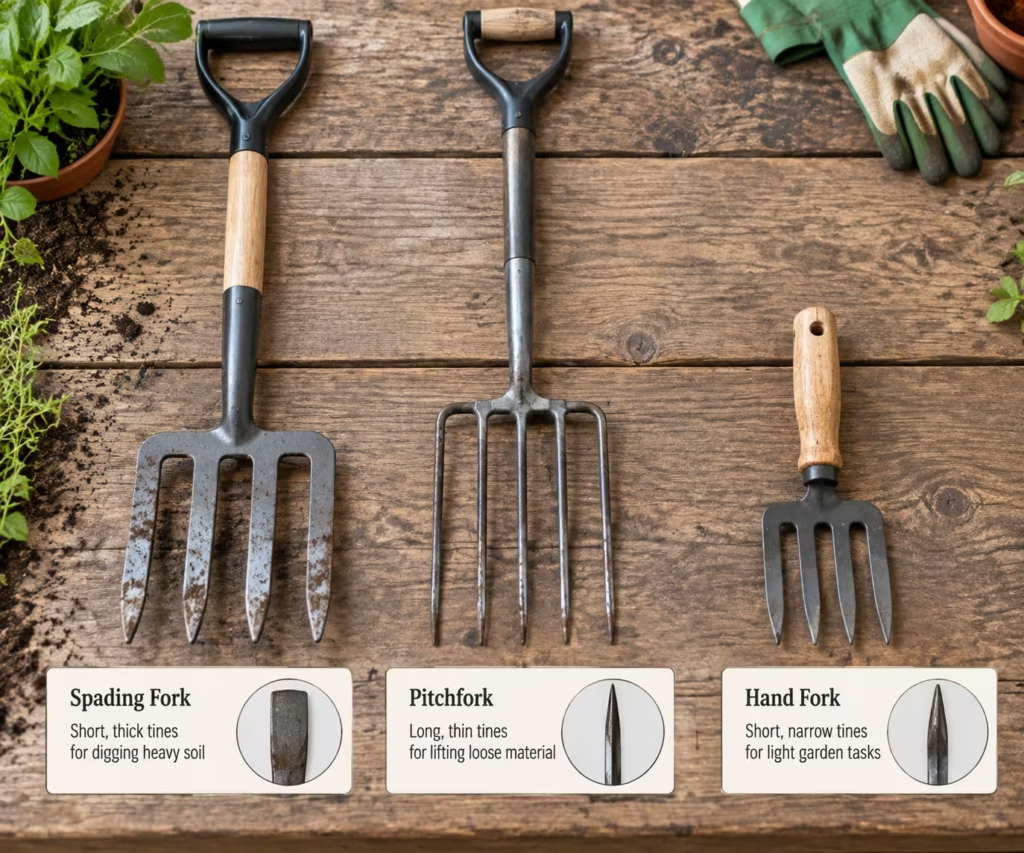
Anatomy of a Garden Fork
- Tines – Usually 4 short, flattened, square or round-shanked prongs made from carbon steel or stainless steel, built to resist bending under digging pressure.
- Tread/Shoulder – A flat ledge above the tines where you can safely place your boot for extra downward force.
- Socket/Shaft – Where the tines meet the handle; a forged, one-piece joint holds up far better than a welded or riveted one under repeated prying.
- Handle – Wood, fiberglass, or steel, usually finished with a D-handle for two-handed grip and leverage.
Types of Garden Forks
- Standard digging/spading fork – Four straight, flattened tines. The general-purpose choice for turning and breaking up soil.
- Potato fork – Wider-spaced, sometimes rounded tines designed to lift root vegetables without piercing them.
- Border/ladies’ fork – A smaller, lighter version of the standard fork, easier to handle in raised beds or for lower-effort digging.
- Broadfork – A wide tool with a horizontal bar and two handles, straddled with both feet to drive multiple long tines deep into soil at once — built for no-dig bed prep over a wider area in one pass.
- Heavy-duty/two-prong fork – Fewer, thicker tines built specifically for breaking through compacted, rocky, or clay-heavy ground.

Material Guide: Carbon Steel vs. Stainless Steel
Carbon steel holds up better against repeated prying pressure and rocky, compacted soil, and can be sharpened if the tines dull — but it needs cleaning and drying to prevent rust.
Stainless steel resists corrosion with minimal upkeep and sheds wet clay cleanly, though it’s typically a bit more expensive for the same tine strength.
If you’re breaking new ground or working heavy clay, carbon steel’s durability under stress is usually worth the extra maintenance. For established beds and lighter soil, stainless steel’s low upkeep wins.
How to Use a Garden Fork the Right Way
- Position your boot on the tread, not on the tines directly, and push straight down using body weight.
- Rock the handle back to lever soil loose rather than lifting straight up, which strains your back.
- For root crops, insert the fork well outside the plant’s base before levering, so tines pass under the roots rather than through them.
- Work in a grid pattern across a bed for even turning rather than random jabs.
- Clean tines after each use — packed soil between them holds moisture and speeds up rust.
How to Choose the Right Garden Fork
- What’s my main task? General bed prep favors a standard spading fork; harvesting root crops favors a potato fork; wide no-dig bed prep favors a broadfork.
- What’s my soil like? Rocky or compacted clay calls for thicker carbon steel tines and a reinforced socket; loose or raised-bed soil is fine with a lighter stainless steel fork.
- How tall am I? Handle length should let you dig comfortably without excessive bending — taller handles suit taller gardeners and deeper work.
- What’s the socket construction? A forged, one-piece neck outlasts a welded or riveted joint, especially under the prying pressure a fork sees more than a shovel does.
Caring for Your Garden Fork
- Hose or brush off soil after every use, particularly from between the tines.
- Dry carbon steel tines fully before storage, with a light coat of oil to prevent rust.
- Check tines periodically for bending — straighten gently with pliers if a tine gets slightly bent, before it snaps.
- Store off the ground, tines up, in a dry space to protect both the tines and the handle.

For More like this Visit Garden Tools Guide
Want to know about hand fork
Frequently Asked Questions
What is a garden fork used for? Turning and loosening soil before planting, digging up root crops like potatoes without damaging them, breaking up compacted clay, aerating beds, and working compost into existing soil.
What’s the difference between a garden fork and a pitchfork? A garden fork has short, thick, flattened tines built for digging into dense soil; a pitchfork has longer, thinner, rounded tines built for lifting loose material like hay or mulch, not for digging.
What’s the difference between a garden fork and a hand fork? Scale and grip. A garden fork is a long-handled, two-handed tool for full-bed digging and turning; a hand fork is a small, single-hand tool for close-up weeding and loosening around existing plants.
What is a broadfork used for? A broadfork lets you drive several long tines deep into a wide strip of soil in one pass by standing on the crossbar, making it popular for no-dig garden bed preparation over a large area quickly.
Is carbon steel or stainless steel better for a garden fork? Carbon steel holds up better under heavy prying in rocky or compacted soil; stainless steel needs far less maintenance and resists rust, making it a better fit for lighter, established garden beds.
What’s the best garden fork for digging potatoes? A potato fork, with its wider-spaced or rounded tines, is built specifically to lift root vegetables out of the ground intact rather than piercing them the way a standard spading fork’s narrower tines might.