🌿 Your trusted guide to choosing the best garden tools.

The Complete Hand Fork Guide: Types, Uses & How to Choose the Right One

Walk into any garden center and you’ll see a wall of forks that all sort of look the same — until you actually need one for a specific job, and suddenly “fork” isn’t specific enough. Digging fork, spading fork, border fork, hand fork… are these all different tools, or just different names for the same thing?
Good news: by the end of this guide, you’ll know exactly which one you’re holding, what it’s built for, and which one belongs in your own tool bag.
A Hand Fork Is Every Gardener’s Close-Work Essential

What Is a Hand Fork?
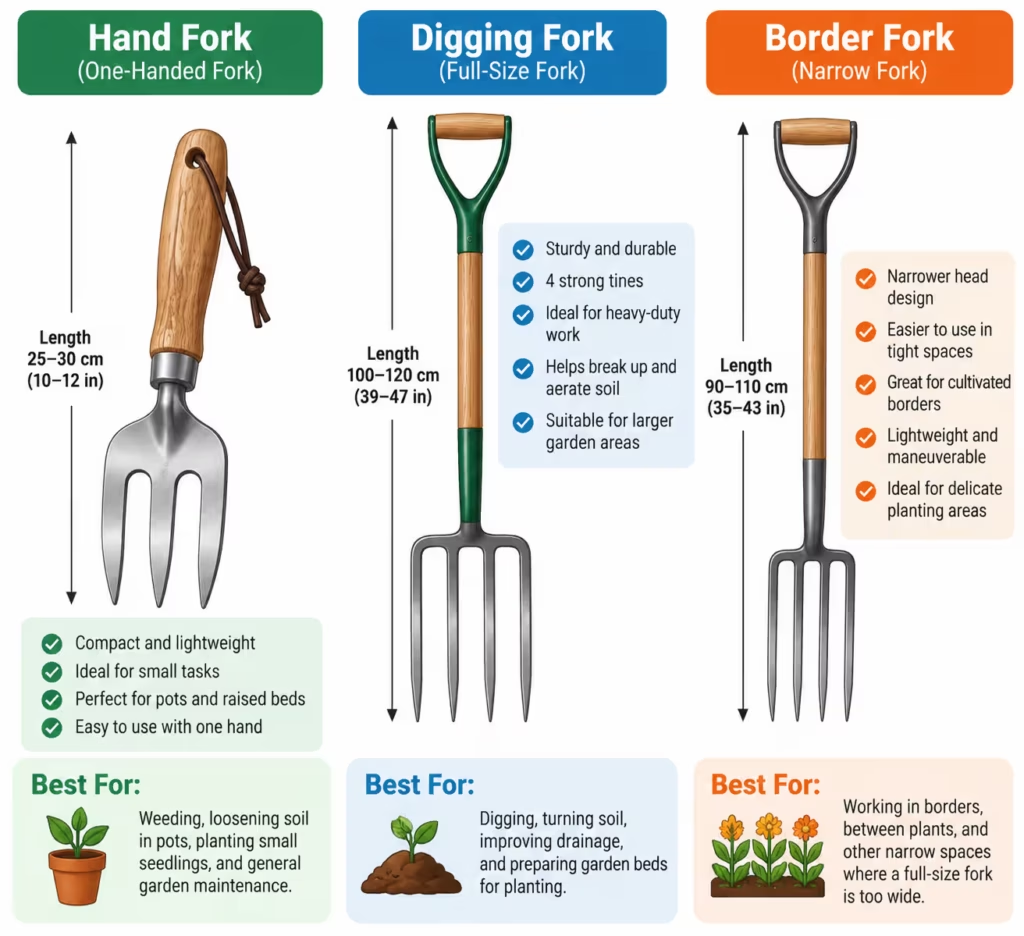
A hand fork is the compact, single-handed cousin of the full-size garden fork — a short handle (usually 9–12 inches) topped with two to four sturdy tines, built for close, detailed soil work rather than heavy digging. Think of it as the fork you reach for when you’re kneeling in a flower bed, not standing over a vegetable plot.
Its defining job is loosening soil without cutting through it the way a trowel or spade does. Tines slide between roots and break up compacted earth, which makes the hand fork the tool of choice anywhere precision matters more than power.
Planting tool vs. Digging Fork vs. Spading Fork: Clearing Up the Confusion
Here’s where most of the mix-up happens — these names get used almost interchangeably online, but they’re not the same tool:
| Tool | Size | Handle | Best For |
|---|---|---|---|
| Hand fork | Small | One-handed, short handle | Weeding, containers, detail work close to plants |
| Digging/spading fork | Full-size | Two-handed, long handle | Turning over garden beds, breaking up compacted or clay soil |
| Border fork | Full-size, narrower head | Two-handed | Working in tight beds without damaging nearby roots |
| Compost/manure fork | Full-size, thin widely-spaced tines | Two-handed | Moving loose mulch, compost, or hay — not for digging soil |
| Potato (lifting) fork | Full-size, wider curved tines | Two-handed | Lifting root vegetables at harvest with minimal damage |
The short version: “digging fork” and “spading fork” are the same tool, just two common names for it. A hand fork is a scaled-down, one-handed version built for a completely different scale of task
Types of Hand Forks
Not every hand fork is built the same way. Here’s how the main variations break down:
1. Standard Hand Fork
Three or four flat, sturdy tines mounted on a short handle — the general-purpose option most gardeners reach for. Good for loosening soil, working compost into beds, and everyday weeding.
2. Weeding Hand Fork
Slightly narrower and more pointed tines, sometimes angled, designed to slide under a weed’s root system and lift it out cleanly rather than snapping it off at the surface.
3. Potting/Transplanting Hand Fork
A smaller, more delicate build meant for container gardening and handling seedlings — where a full-size fork would do more harm than good.
4. Heavy-Duty Hand Fork
Thicker, often square-profile tines (frequently stainless or carbon steel) built to handle tougher, more compacted soil without bending — worth the upgrade if you garden in clay.
Four Hand Fork Types, Side by Side

What Are Hand Forks Made Of?
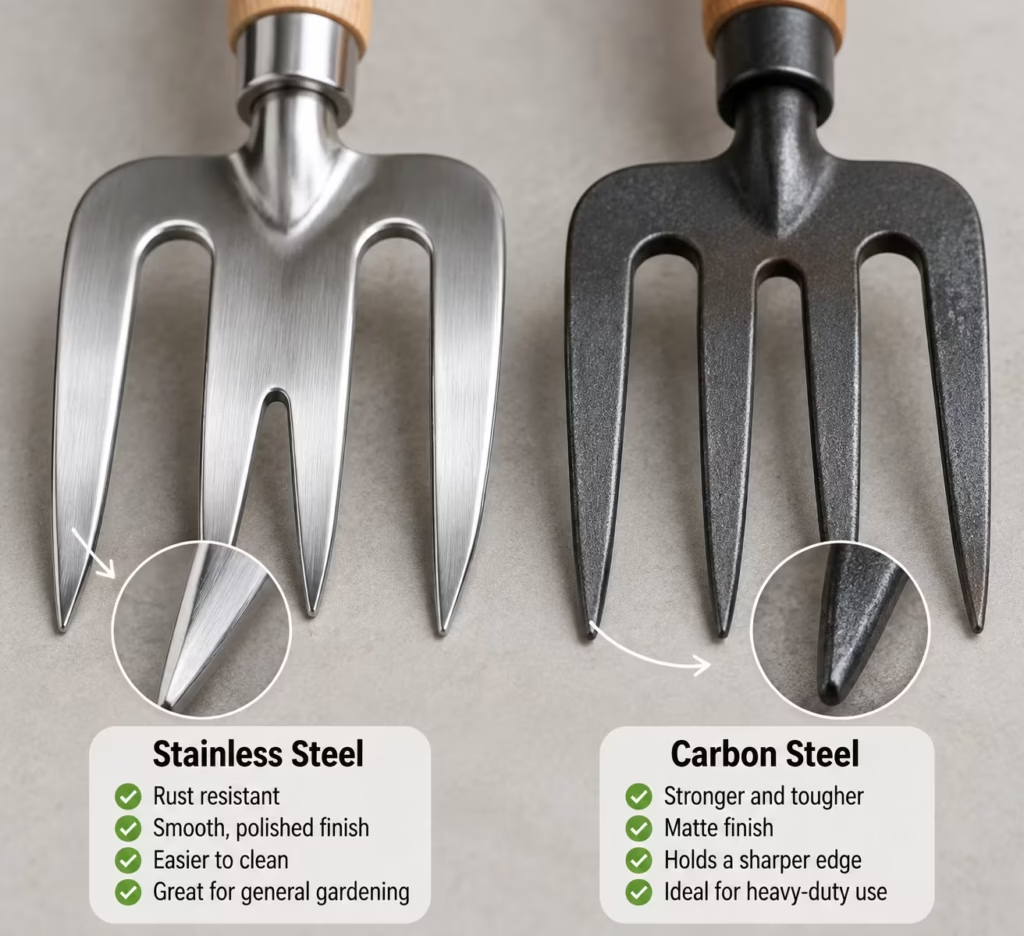
- Stainless steel — Rust-resistant and low-maintenance; the go-to if you garden often or live somewhere humid.
- Carbon steel — Strong and holds its shape well under pressure, but needs drying and the occasional wipe of oil to avoid rust.
- Coated/painted steel — A budget-friendly middle ground; fine as long as the coating stays intact.
For the handle, wood (often ash) is the traditional, comfortable choice, while molded or rubberized ergonomic grips reduce hand strain over longer sessions and hold up better outdoors.
One build detail worth checking before you buy: whether the tines and neck are forged as one solid piece rather than welded together. A one-piece build is far less likely to bend or snap where the tines meet the shaft — the single most common failure point on cheaper hand forks.
Stainless vs. Carbon Steel: Spot the Difference
What Is a Hand Fork Used For?
- Loosening compacted soil around existing plants without disturbing roots
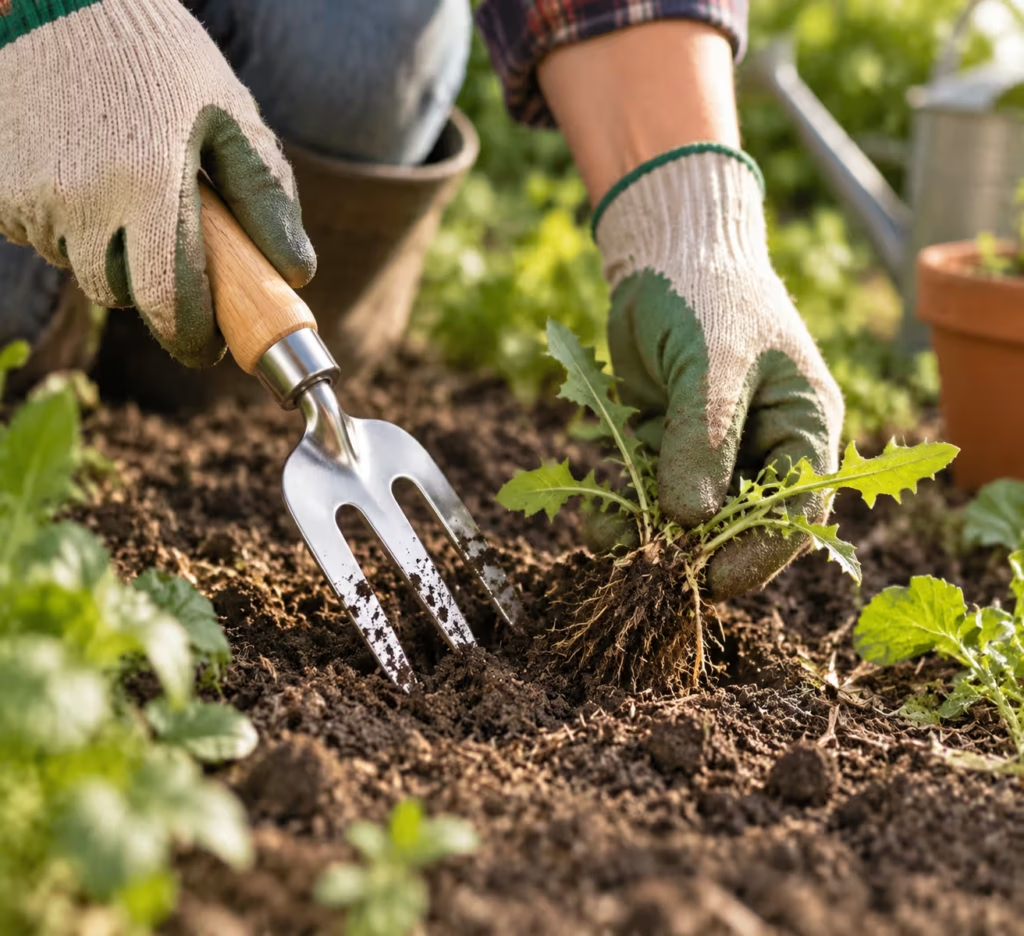
- Weeding — sliding under root systems to lift weeds out whole
- Breaking up soil clods before planting
- Working compost or soil amendments into beds
- Aerating potting mix in containers and raised beds
- Dividing small perennials
- Tidying and cultivating around tight plantings and borders
- Light harvesting of shallow root vegetables in small garden spaces
Weeding with a Hand Fork the Right Way
How to Choose the Right Hand Fork
Ask yourself these before you buy:
- What’s your soil like? Heavy clay calls for thicker, heavy-duty tines; light or potting soil is fine with a standard fork.
- What’s the main task? Weeding favors narrower, pointed tines; general soil work favors a wider, flatter head.
- Where are you working? Containers and raised beds are easiest with a smaller, lighter fork; in-ground beds can take a sturdier one.
- How often will you use it? Occasional use — a mid-range stainless steel fork is plenty. Frequent or heavy use — pay for one-piece (forged) construction; it’s the part that fails first on cheaper models.
Most gardeners end up pairing a hand fork with a hand trowel — the fork loosens and aerates, the trowel digs and scoops — and the two together cover the majority of close-range garden work.
Caring for Your Hand Fork
- Rinse soil off after each use; dried mud speeds up rust on steel tines.
- Dry the tines fully before storing, especially with carbon steel.
- Wipe carbon steel tines with a light coat of oil now and then to prevent rust.
- Check where the tines meet the handle each season — that joint is the first place a lower-quality fork will crack.
- Store it hung up or sheathed rather than loose in a bucket, where the tine tips can bend against other tools.
Frequently Asked Questions
Is a hand fork the same as a digging fork? No. A digging fork (also called a spading fork) is a full-size, two-handed tool for turning over soil in garden beds. A hand fork is a small, single-handed version for close, detailed work like weeding and container gardening.
What’s the difference between a hand fork and a hand cultivator? A hand fork has straight tines for loosening soil and lifting weeds; a hand cultivator has curved, claw-like tines built specifically for scratching and mixing the top layer of soil. Many gardeners own both, since they suit slightly different motions.
Can a hand fork replace a hand trowel? Not entirely — they do different jobs. A trowel digs and scoops soil; a fork loosens and aerates it without cutting through roots. Most gardeners keep both on hand.
What material lasts longest for a hand fork? Stainless steel generally offers the best combination of strength and rust resistance, though a well-maintained carbon steel fork (dried and oiled after use) can last just as long.
How do I stop my hand fork from bending? Look for one-piece forged construction rather than welded tines, avoid using it to pry up rocks or roots it isn’t built for, and choose heavier-gauge tines if you regularly work compacted or clay soil.
Ready to add one to your kit? Match the tine shape to your main task — pointed for weeding, flat and sturdy for general soil work — and check for one-piece construction if you’ll be using it often. Pair it with a hand trowel, and you’ve got the two tools that handle almost everything close to the ground.